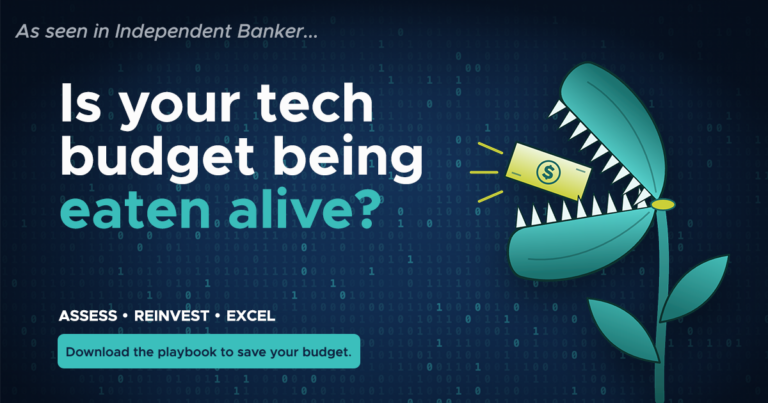

If you’re weighing whether to upgrade your community bank’s core technology or keep your legacy system, the pros and cons seem readily apparent. Upgrading expands your capabilities and services, but at a significant cost; the status quo, on the other hand, limits what you can offer, but it isn’t really costing you more than routine fees and maintenance.
Or so you think: In actuality, your legacy system could be costing you—a lot. In fact, new research by tech provider RS2 Technologies found banks on average spend 70% of their budgets on legacy system maintenance, keeping them “patched” as components break down or become obsolete.
And that’s just spending you can see: numerous “shadow” costs might also be eroding your bank’s profitability.
That’s why it’s imperative that you know the spending tally on your current technology. Here are 7 potential cost eaters to investigate that could be thinning out your bottom line.
- Redundant Systems. Whether you know it or not, your legacy system may have multiple components or products performing the same function. For example, you may be using two similar products because one can do something the other can’t, and vice-versa. This kind of redundancy inflates costs without improving efficiency.
- Disparate Systems. Older core systems often have components that aren’t integrated—they can’t communicate, share data or perform in conjunction with each other. In this case, your expenses may be exceeding those of a fully integrated system.
- Old Hardware. Like any other class of equipment, computer hardware experiences wear and tear, leading to escalating repair costs. And the older the hardware, the scarcer and more expensive replacement parts become—as well as the technical expertise to fix it.
- A Bloated System Package. The system package you bought with all the “bells and whistles” may not have turned out quite the way it was promoted. You may eventually notice that not all of the products built into your system are actually useful to you or your customers. Even so, you could still be paying for these unnecessary items within your subscription fee structure.
- Lack of Oversight. After the excitement around a system launch ebbs and everyone settles back to routine operations, it’s easy to become lulled into complacency. If you’re not paying attention, your system’s subscription renewals and other fees (which are often automated) may stack up and start costing you more than you realize.
- IT Third-Party Expenses. Many community banks don’t find it cost-effective to employ a dedicated IT technician, so they outsource system repairs and maintenance. As the legacy system ages, however, these outsourced expenses might actually equal the cost of a full-time technician on staff.
- Hidden Contract Costs. Like other SAAS contracts, core banking provider agreements are often highly technical, complex, and (perhaps by design) confusing. Without legal scrutiny, a bank may find themselves continually paying for hidden expenses and fees authorized deep within the contract language.
When you take into account these legacy system cost-eaters, a community banker should no longer be asking whether their bank can afford to take the upgrade leap, but whether they can afford not to.
To aid in this process, IBT Apps, a leading community bank core technology provider, encourages bankers to ask a couple of big picture questions: What is your current system actually costing you in bloated expenses and lost opportunities? And what can your bank gain—or streamline in the long-term—if you invested in a complete technology upgrade?
It won’t be easy—it takes both a savvy customer and a transparent core provider to avoid runaway costs. In the end, though, you just might be able to acquire a new core system that actually fits the needs of both your bank and your customers, and a more reasonable impact on your bottom-line than your current system.
Solving the Internal Conflict Between Innovation & Cost Control
It makes sense—get rid of the cost eaters in your technology and technology strategy, and not only save money, but also open up room for tech upgrades and additions. But where do you start? And after you start and see money savings, what’s the first step in looking for new tech options?
Assess Your Current Technology
First, take an assessment of your current tech stack and make sure to involve your team as they will also benefit from the efforts both in the present and future. We recommend using our guide on Innovation and Cost Control as a blueprint for assessing your technology.
Work with a Trusted Tech Provider
Next, find a technology provider that not only offers the modern technology that fits your bank’s needs, but also is willing to work with your bank on pricing so your bank doesn’t experience Groundhog’s Day and end up with the same cost eaters that drain your budget.
We have developed an innovative pricing model that helps clients avoid the money pit of hidden fees and unnecessary products, and obtain a new, streamlined banking system that delivers results for your bank and customers. It’s called IBT ONE — our all-in-one subscription that rolls every product into a single, predictable price, so you always know exactly what you’re paying for and what you’re getting in return. For community bankers, that means no more surprise line items or paying for products you don’t use — just one straightforward subscription that grows with your bank. If you’d like to see how it works, you can learn more about IBT ONE here.
Innovation Is Closer Than You Think
At the end of the day, legacy technology rarely stays quietly in the background — it chips away at your margins, your flexibility, and your ability to serve customers the way they expect to be served today. Taking an honest look at where your money is actually going is the first real step toward fixing it. With the right partner and a pricing model built on transparency, upgrading doesn’t have to be the daunting, expensive leap it once seemed. It can be the move that frees your bank from constant upkeep and unnecessary spend, and opens the door to real, lasting growth.
Connect with us to discuss how IBT One can benefit your bank.